Compound or standalone building in Sharm El Sheikh: what the money buys, when it is worth it and how to choose
Gated grounds with a pool and security cost more to run and live by their own rules. What exactly is bought with a flat in a compound, what is lost in an ordinary building, where each format fits and which questions to ask before the deal.
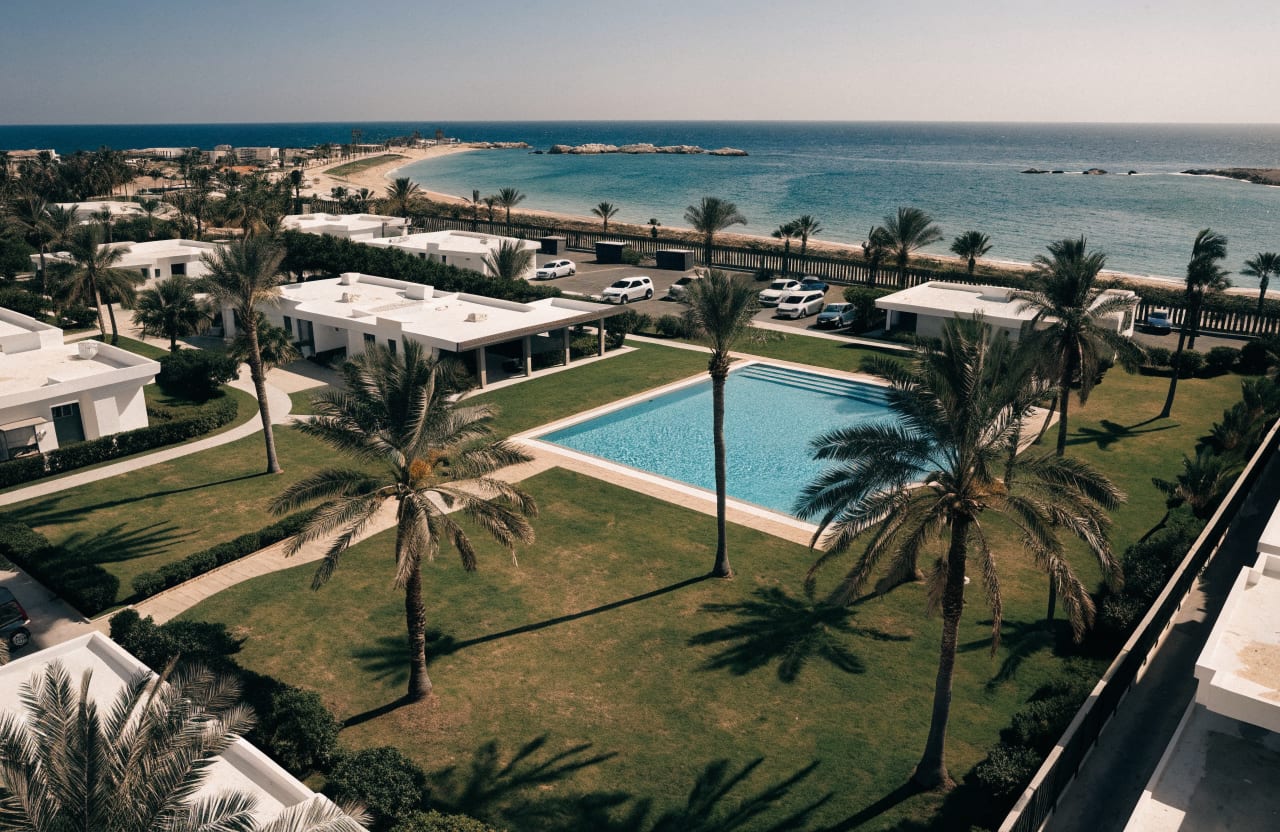
In Sharm El Sheikh a flat can be bought in two fundamentally different forms: in a compound — a gated residential complex with shared grounds, pools, security and a management company — or in an ordinary building on a street, where the neighbours share only the stairwell and the roof. It is not a difference in price or in class. It is two different ways of owning, differently arranged in daily life, in costs and in risks, and the choice should be a conscious one.
What is bought with a flat in a compound
A compound is not a pool, as people often think. It is a set of engineering and organisational things that in Sharm matter more than a pool: security at the gate and control over who enters; its own water treatment and storage tanks that smooth the town's uneven supply; a generator that keeps the lifts, pumps and sometimes the flats running during cuts; cleaning of the grounds and waste removal; maintenance of pools and gardens; a management company you can go to with a problem. All of it is paid for by the service charge the owners pay.
The charge is the key word. It is not one-off: it stays with the flat for good, usually rises and is paid whether you live there or the flat stands empty ten months a year. How it works, what it covers and how to read its size has its own article.
What an ordinary building gives — and does not
An ordinary building on a street in Hadaba or Naama is cheaper to run: no service charge or a token one, with neighbours agreeing shared costs among themselves. Nor are there a compound's restrictions: nobody asks who your guests are or bans nightly letting by the rules of the grounds. But there are no grounds, pool, security or generator either — and the state of the stairwell, roof, tanks and lift depends on whether the neighbours agree and pay. In a building where half the flats stand empty, there is nobody to agree with.
In Sharm an ordinary building is most often the choice for one's own permanent home in residential areas where daily life works without a compound: shops, workshops and schools close by, permanent neighbours. For letting to tourists and for rare visits from another country the format fits less well.
Rules: what the compound decides for you
Compounds have internal rules: who may enter the grounds, whether nightly letting is allowed, whether pets are, when noise and renovation are permitted, where to park. They outrank your plans — a breach means a conflict with the management and fines. If the purchase is meant for letting, establish the rules in writing before the deal: a ban on nightly lets closes the scenario entirely. If the purchase is for living, the same rules are a plus: quiet and predictable neighbours.
Occupancy: a living compound versus an empty one
A compound's main risk is not a high charge but an empty complex. If a quarter of the flats are occupied, few pay the charge, the management has nothing to keep the grounds with, the pool turns green, security leaves, and the tended garden of the render becomes a view of waste ground. So occupancy must be checked: come in the evening and count the lit windows, ask the manager how many flats pay, look at the pool and the lawns. A new compound may be empty for a while; an old one may be empty for good.
Where each format fits
- Naama Bay: many ordinary buildings by the promenade and large compounds on El Salam Road — a choice between 'everything on foot' and 'quiet with grounds'.
- Hadaba: the widest choice of ordinary buildings for living and compounds of different years; the area where an ordinary building is the norm.
- Montazah: almost only small compounds by a private beach.
- Nabq: compounds only, often large; practically no ordinary buildings.
- Sharks Bay and Ras Um Sid: a few complexes by the water.
Costs: compare the cost of owning, not the price
A flat in an ordinary building may be cheaper to buy and to run, but it needs your involvement in keeping the building and carries the neighbour risk. A flat in a compound costs more and pays a charge, but frees you from part of the cares and provides services that in Sharm are not a luxury. An honest comparison adds the purchase price and the charge over the expected years of ownership — and remembers that a high charge, all else being equal, lowers the price at resale.
Questions before the deal
- The service charge, what it covers, when it was raised, whether the flat or the complex has arrears.
- Who manages the grounds — the developer, a hired company or the owners themselves — and how to reach them.
- The rules: nightly letting, pets, guests, parking, renovation.
- Occupancy: how many flats are lived in all year, how many pay the charge.
- Services: tanks, water treatment, generator and what it feeds.
- For an ordinary building: who the neighbours are, how shared matters are settled, the roof and tanks, who pays for the lift.
Najczęstsze pytania
What is a compound in Sharm El Sheikh?
A gated residential complex with shared grounds: security, pools, gardens, water treatment, a generator, a management company. All kept with the owners' service charge.
How is an ordinary building better than a compound?
Cheaper to run, no service charge and no grounds rules. But no security, pool or generator, and the building's condition depends on the neighbours.
Is the service charge paid when I do not live in the flat?
Yes, always. The charge stays with the flat regardless of whether anyone lives there, and usually rises.
Can a compound flat be let by the night?
It depends on the complex's rules: some forbid or restrict it, hotel complexes allow it only through the administration. Find out in writing before buying.
How can I tell a compound is well kept?
Occupancy (lit windows in the evening), a clean pool, tended lawns, working lifts, a reachable manager, no arrears on the complex.
Which areas of Sharm have ordinary buildings?
Mostly Hadaba and the blocks by Naama's promenade. Nabq and Montazah are almost only compounds.
Furnished or unfurnished: what really stays in the flat and what it is worth
'Furnished' in Sharm means anything from a full kit to three pieces and the curtains. What usually stays, when furniture is a plus and when an overpayment, how to value it when negotiating and how to draw up the inventory so there is no dispute at handover.
What affects the price of a flat in Sharm: the multipliers that pull two similar flats apart
Square metres are not the main multiplier. Water and view, area and buyer, the building and its management, the service charge as price over time, readiness, floor and documents: the mechanics of price without figures, and how to read the real premium in the catalogue.
Flat handover in Sharm El Sheikh: what to check, how to record it and why not to hurry
After handover the defects are your concern and your money. What to bring, what must be checked — water, electricity, air-conditioning, windows, terrace, area, common areas — how to record defects, what to do afterwards and how to accept remotely.